



Forestry Winches: Improve Your Log Accessibility, Bring the Logs to the Trail
Chapter 3 of the Woodland Mills Log Extraction Guide
One limitation shared by both direct skidding and logging arches is access. These low cost solutions are great for dragging logs off-road or through trails, but cannot help you with accessing logs on steep, sloped terrain or in dense foliage.
Whether you are dragging a log with a chain or carrying it beneath a logging arch, the tow vehicle still has to reach the log.
That means:
-
-
Building access trails
-
Driving farther into the woodlot
-
Navigating around standing timber
-
Potentially disturbing more soil
-
For many landowners, this works perfectly well.
-
But as harvesting becomes more selective or the terrain becomes more difficult, building a trail to every log can become impractical.
This is where forestry winches shine.
Models like the FW66 and FW88 focus on bringing the log to the tractor, rather than driving the tractor to the log.
Advantages to Tractor-Mounted Forestry Winches
Pull the Log, Not the Tractor
For many woodlot owners, a tractor-mounted forestry winch is one of the most valuable tools in the woods.
The process is straightforward:
-
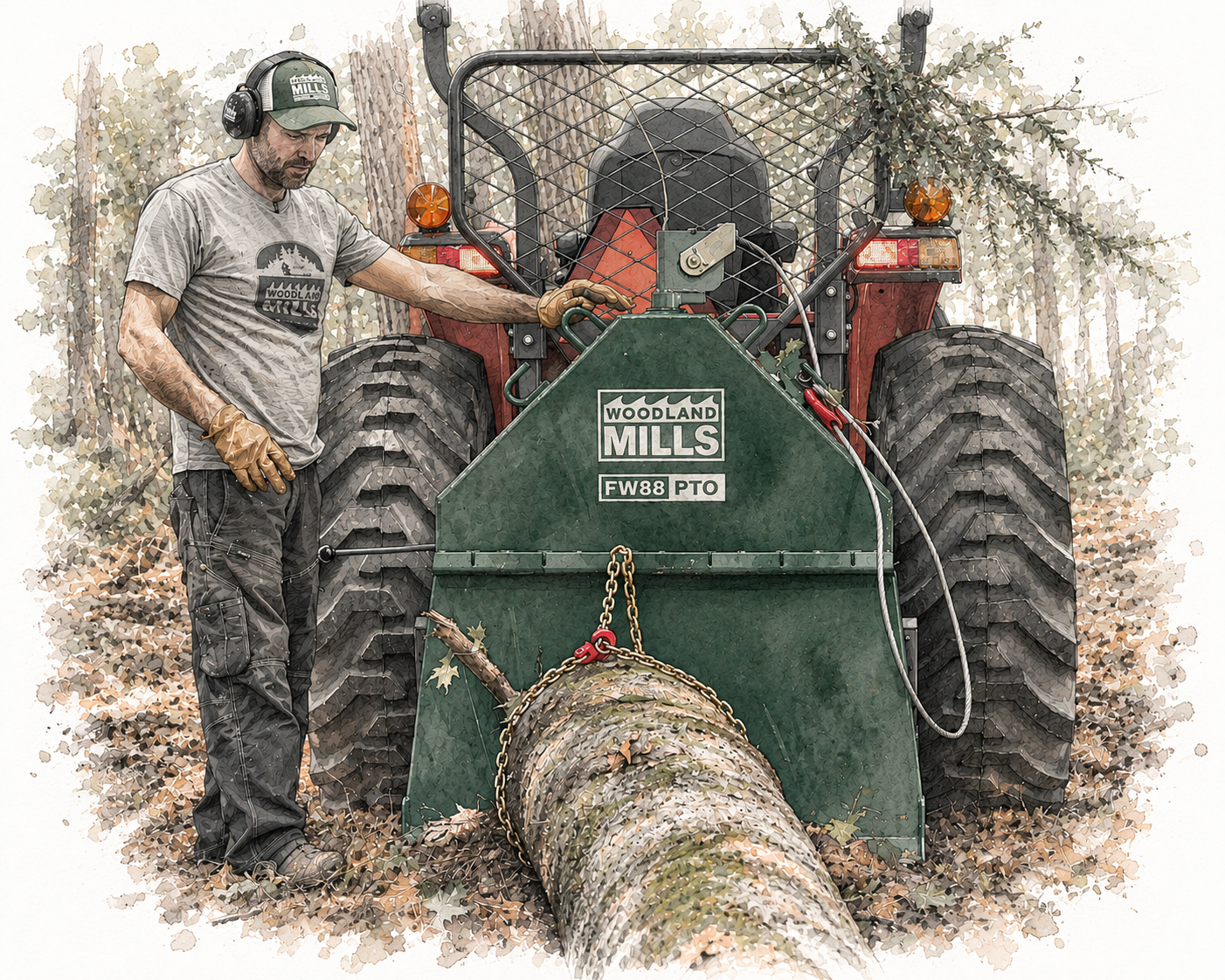
- Position the tractor on an established trail.
- Pull the winch cable out to the log.
- Attach the cable using a choker chain.
- Winch the log back to the tractor.
As long as the cable can reach the log, the tractor does not need to.
This allows landowners to retrieve timber from deeper within the forest while keeping the tractor on an established trail.
Benefits
-
-
Fewer access trails required
-
Less soil disturbance
-
Reduced damage to standing trees
-
Access to difficult terrain
-
Easier selective harvesting
-
Let the Winch Do the Heavy Pulling
-
One of the biggest advantages of a forestry winch is its ability to generate pulling force. With direct skidding, the tow vehicle can pull only as hard as its available traction allows. Long before the engine reaches its limits, the tires may begin to slip.
A forestry winch changes that. Once the butt plate is lowered and firmly set against the ground, the tractor gains a solid point of resistance. Instead of relying primarily on tire traction, much more of the tractor’s available power can be converted into pulling force through the winch.
This creates a pulling system capable of moving logs that may be difficult or impossible to drag directly with the tractor alone. The additional pulling force also creates another major advantage: productivity.
Multiple choker chains can be attached to separate logs and used to retrieve those logs during a single pull. Instead of making repeated pulls for individual stems, you can bring a group of logs back to the tractor at the same time.
For many woodlot owners, the ability to concentrate pulling force and retrieve multiple logs at once is one of the greatest advantages of a tractor-mounted forestry winch.
As with direct skidding, a skidding cone can help the leading ends slide over obstacles and reduce the likelihood of the logs hanging up while being winched.
More Than Just a Winch
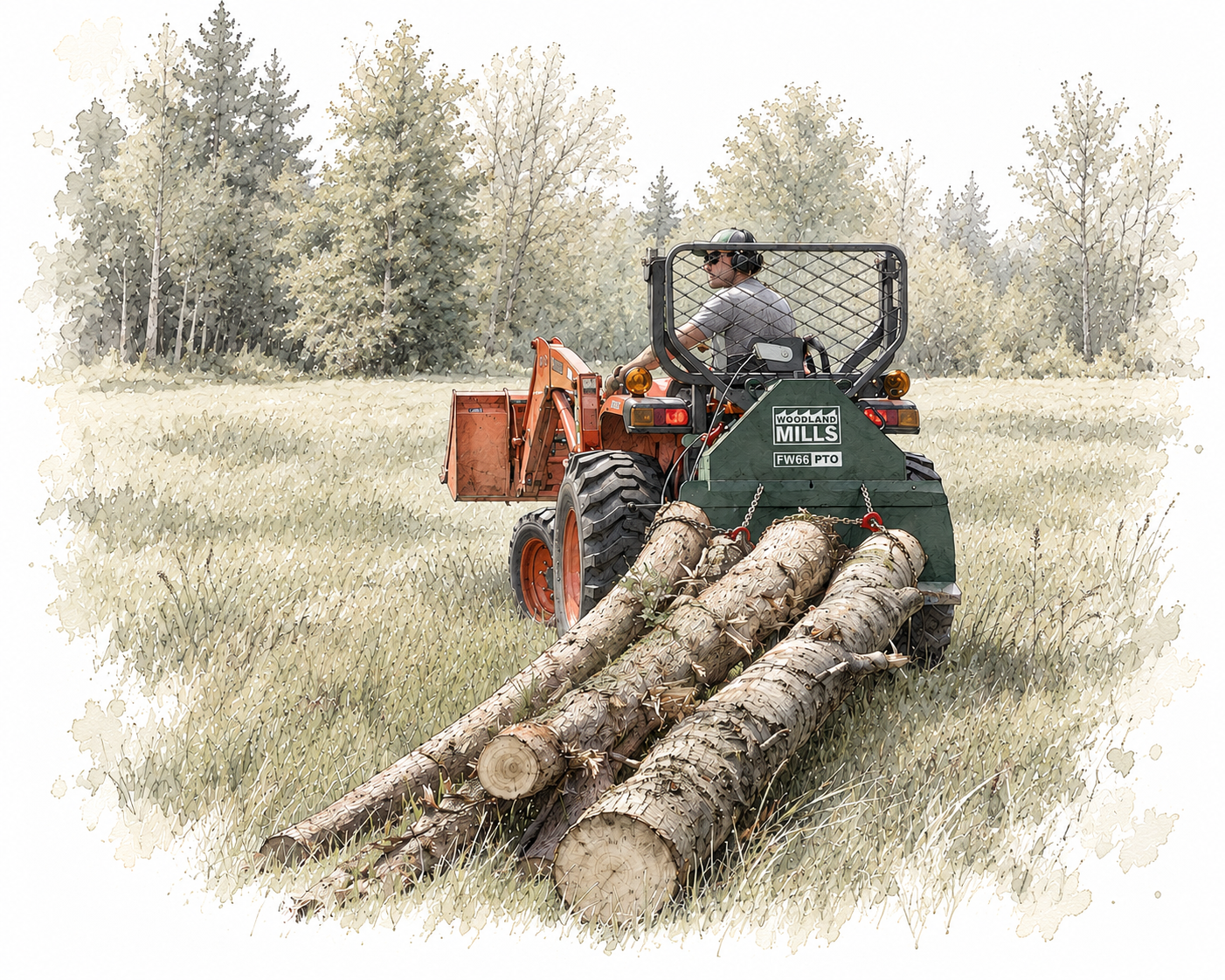
A tractor-mounted forestry winch does more than retrieve logs to the trail.
Most forestry winches incorporate:
-
-
Choker-chain storage
-
A stabilizing butt plate
-
The ability to raise the leading ends of the logs for transport
-
Once the logs reach the tractor, the chokers can be secured for transport so the leading ends are lifted clear of the ground. The tractor can then transport the logs out of the woods by skidding them behind the tractor.
In effect, the forestry winch begins performing a role similar to a logging arch:
-
-
The leading ends are raised
-
Ground contact is reduced
-
Pulling resistance decreases
-
The logs track more predictably behind the tractor
-
Multiple logs can be transported together
-
A tractor-mounted forestry winch therefore solves two separate extraction challenges:
-
-
Retrieving logs to the tractor
-
Transporting the logs out of the woods
-
For many woodlot owners, this reduces the need to build trails to every tree while providing many of the transport benefits of a logging arch. You can even use an LD20 Log Dolly with a forestry winch to ensure the trailing end is also raised, protecting the log from snagging or dragging.
Portable Capstan Winches
Portable capstan winches solve a different problem.
A portable capstan winch does not require the landowner to own a tractor or invest in a tractor-mounted forestry winch. The winch can be transported in an ATV, UTV, or pickup truck and carried into the work area by hand.
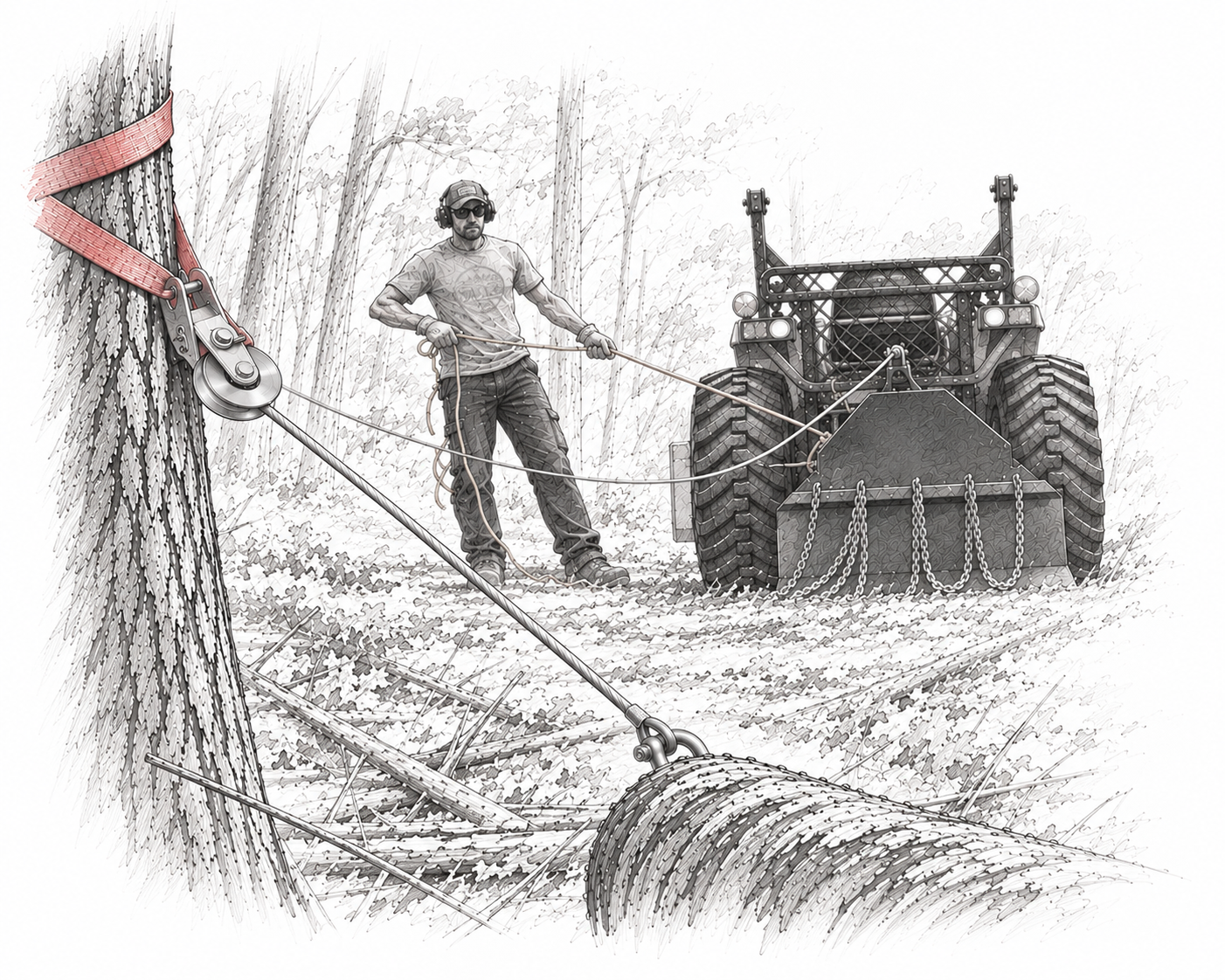
A common approach is to leave the tow vehicle on an established trail and anchor the capstan winch to a suitable tree near the trail’s edge.
From that position, the rope can be extended into the woods and used to pull logs back toward the trail from distances of up to 200 feet, depending on the available rope, terrain, and operating conditions.
This makes portable capstan winches valuable when:
-
-
The landowner does not own a tractor
-
A tractor-mounted forestry winch is not available
-
Terrain is steep
-
Tow-vehicle access is limited
-
Building additional trails is undesirable
-
Logs are located well off existing trails
-
Rather than driving a tow vehicle to every log, the logs are brought closer to the trail and to the equipment waiting there.
For many landowners, this provides a practical and more affordable way to retrieve timber from areas that would otherwise be difficult to access.
The Trade-Off of Capstan Winches
The portability and lower cost of a capstan winch come with limitations.
Compared with a tractor-mounted forestry winch, portable capstan winches generally have less available power, lower pulling force, and slower retrieval speeds.
A portable capstan winch is generally better suited to individual logs or smaller loads. The reduced pulling force and retrieval speed are the trade-offs for portability, lower cost, and the ability to work without a tractor.
What Capstan Winches Do Not Solve
Portable capstan winches are excellent at retrieving logs to a trail. However, once the logs reach the trail, they still need to be moved to the landing, sawmill, firewood area, or storage pile.
The logs must still be:
-
-
Skidded directly
-
Moved with a logging arch
-
Loaded onto a trailer
-
Transported to the landing
-
A portable capstan winch extends the reach of the extraction system. It does not replace the equipment needed to transport the logs from the trail to the landing.
Key Takeaway
Forestry winches like the FW66 or FW88 make it possible to retrieve logs without driving a tow vehicle to every tree. This reduces the need for additional trails, helps protect soils, and allows landowners to access timber that would otherwise be difficult to reach.
The difference is what happens after the logs are retrieved.
A portable capstan winch retrieves logs to the trail. A tractor-mounted forestry winch retrieves logs to the tractor and helps transport them from the woods
Want to learn more about how an off-road ATV trailer can transform log retrieval and cargo hauling? Check out Chapter 4 to read more about it.
The Woodland Mills Log Extraction Guide: Learn more about every step, piece of equipment and stage of log maneuvering, from low-cost skidding to more specialized equipment and knowledge.
Chapter 1: Direct Log Skidding
Chapter 2: Log Arches
Chapter 3: Forestry Winches
Chapter 4: Utility Trailers
Join the Woodland Mills Community Facebook group. Search advice and insights from over 65,000 knowledgeable, supportive members.
- Pre-purchase considerations
- Sawmill set-up support
- Project inspiration photos and videos
- Community troubleshooting support