



The Woodland Mills Log Extraction Guide
Introduction: Every Log Has a Journey
If you own a woodlot, cut firewood, or mill your own lumber, cutting the tree is only part of the job.
The next challenge is getting the log from where it fell to where it can be milled, split, stacked, or stored. This guide walks through the most common ways landowners retrieve, move, load, and transport logs, from simple low cost methods to more capable woodlot systems.
Moving a log is often harder than cutting it.
Most landowners spend their time researching chainsaws, sawmills, and firewood processors. Then the first tree is cut, and a very practical question shows up:
How do I get this log out of the woods?
For some landowners, the answer is a chain and an ATV. For others, it is a logging arch, forestry winch, trailer, or professional forestry trailer with a hydraulic crane.
The best extraction method depends on log size, terrain, hauling distance, ground conditions, how much wood you need to move, and the equipment you already have available.
Each method solves a different problem. This guide explores the strengths, limitations, and trade-offs of the most common extraction methods used by modern woodlot owners.
Safety note: Logs are heavy, unpredictable, and can move quickly once under tension. Always follow the manufacturer’s instructions for your equipment, use properly rated chains, chokers, winches, trailers, and rigging, and stay within the limits of your tow vehicle, tractor, or trailer. Terrain, slope, ground conditions, and log weight can change quickly, so take your time, plan your route, and work safely.
Direct Log Skidding: The Simplest, Lowest Cost Way to Move Logs Around Your Property
Chapter 1 of the Woodland Mills Log Extraction Guide
Direct skidding remains one of the most affordable and accessible ways to move logs. With little more than a chain and an ATV, UTV, tractor, pickup truck, or other tow vehicle, landowners can begin extracting firewood and sawlogs without investing in specialized forestry equipment.
In this chapter we'll dive into the advantages and disadvantages of direct log skidding for landowners looking to do low-cost log extraction, before moving onto more advanced techniques and specialized equipment in future chapters.
Know Your Trail
Every root, rock, stump, standing tree, and branch becomes a potential snag point during direct skidding.
Planning the route ahead often has a greater impact on success than adding more horsepower.
Why Direct Skidding Is So Popular
For many landowners, direct skidding is the natural starting point, especially if you already have an ATV, UTV, tractor, or pickup available.
The concept is simple: attach a chain or choker to a log and pull it with a tow vehicle you already own.
Benefits
-
-
Lowest-cost extraction method
-
Uses existing equipment
-
Minimal setup required
-
Effective for occasional firewood and sawlog movement
-
When distances are short and ground conditions are firm, direct skidding can be surprisingly productive.
Understanding the Challenges
The challenge is rarely attaching the log. The real challenge is getting it through the woods, which is why the extraction route matters so much.
Unlike equipment traveling on wheels, the entire log must navigate every root, stump, rock, branch, and tight turn along the trail. A tow vehicle may have enough power and traction to pull the log, but a single snag can quickly bring everything to a stop.
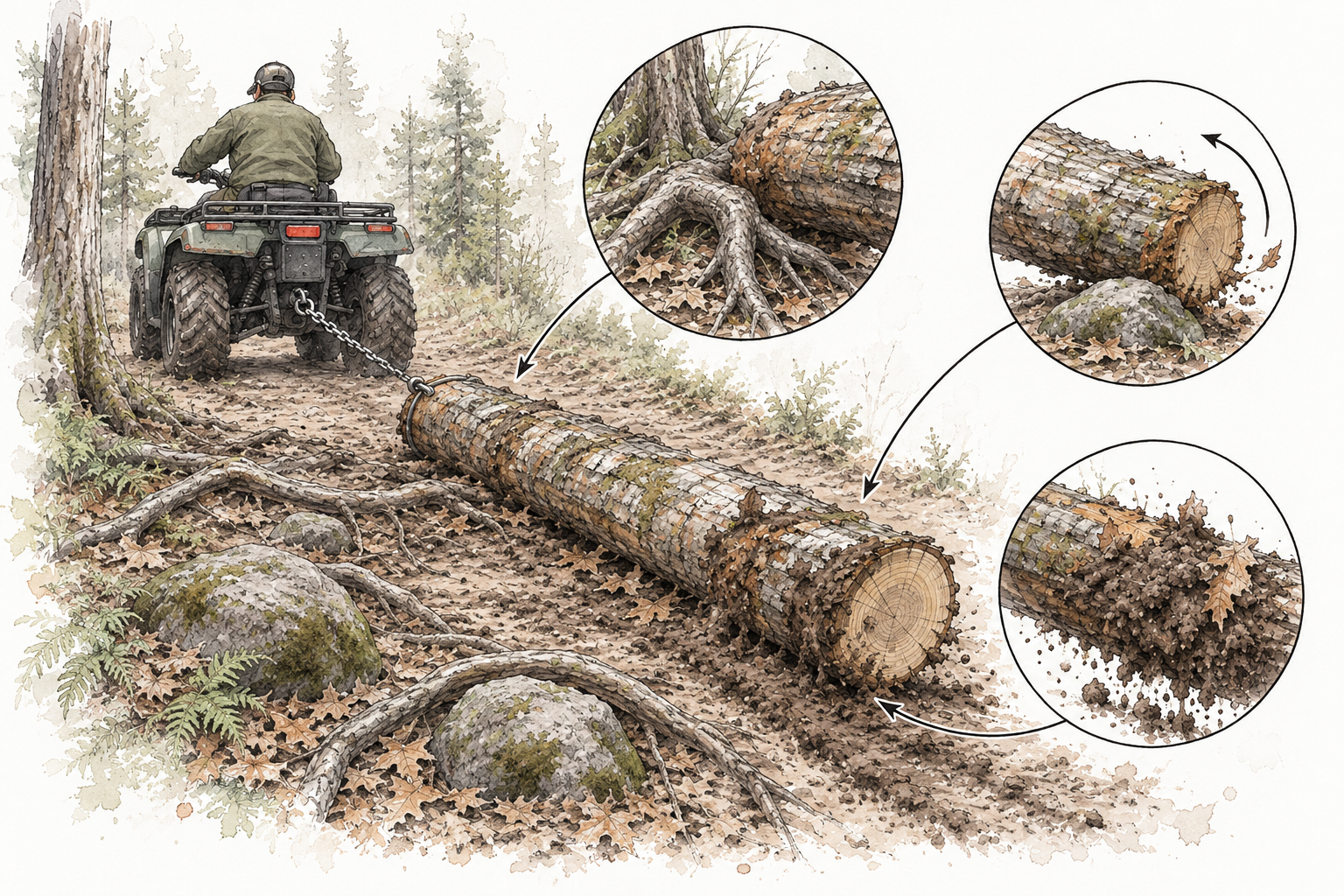
1. The Log Has a Mind of Its Own
As the log moves across uneven terrain, it constantly reacts to its surroundings.
A log may:
-
-
Roll unexpectedly
-
Swing left or right
-
Drift across the trail
-
Pivot when one side catches an obstacle
-
Change direction as terrain conditions change
-
This behavior becomes even more noticeable when moving tapered logs, large hardwood stems, or logs with remaining branch stubs.
You are not just pulling the log. You are continuously managing how it tracks through the woods. A log that starts out traveling perfectly behind the tow vehicle can quickly move off-line after encountering a root, stump, or rock.
2. The Hidden Cost of Snags
One of the biggest frustrations with direct skidding is the sudden stop.
A log may slide smoothly for hundreds of feet before catching on a root or stump.
When that happens, the sudden load is transferred directly into:
-
-
The chain or choker
-
The tow point
-
The tow vehicle
-
Repeated shock loads create unnecessary wear and make extraction less predictable and efficient.
3. Consider the Condition of the Log
Direct skidding can also be hard on the log itself.
Because the log is dragged directly across the ground, bark is frequently scraped away and the surface can become damaged from repeated contact with roots, rocks, and stumps.
Ground conditions play a major role.
On frozen ground, logs generally stay cleaner and slide more easily, making winter one of the best times to skid timber. However, those same frozen conditions may reduce traction for the tow vehicle. The log may pull more easily while the tow vehicle struggles for grip.
In warmer conditions, logs tend to pick up dirt, mud, sand, and small stones. This may not matter as much for firewood, but it can be a significant consideration for sawmill owners. Dirty logs can dull blades faster, increase maintenance requirements, and reduce milling efficiency.
The less ground contact a log has during transport, the cleaner and better protected it will remain.
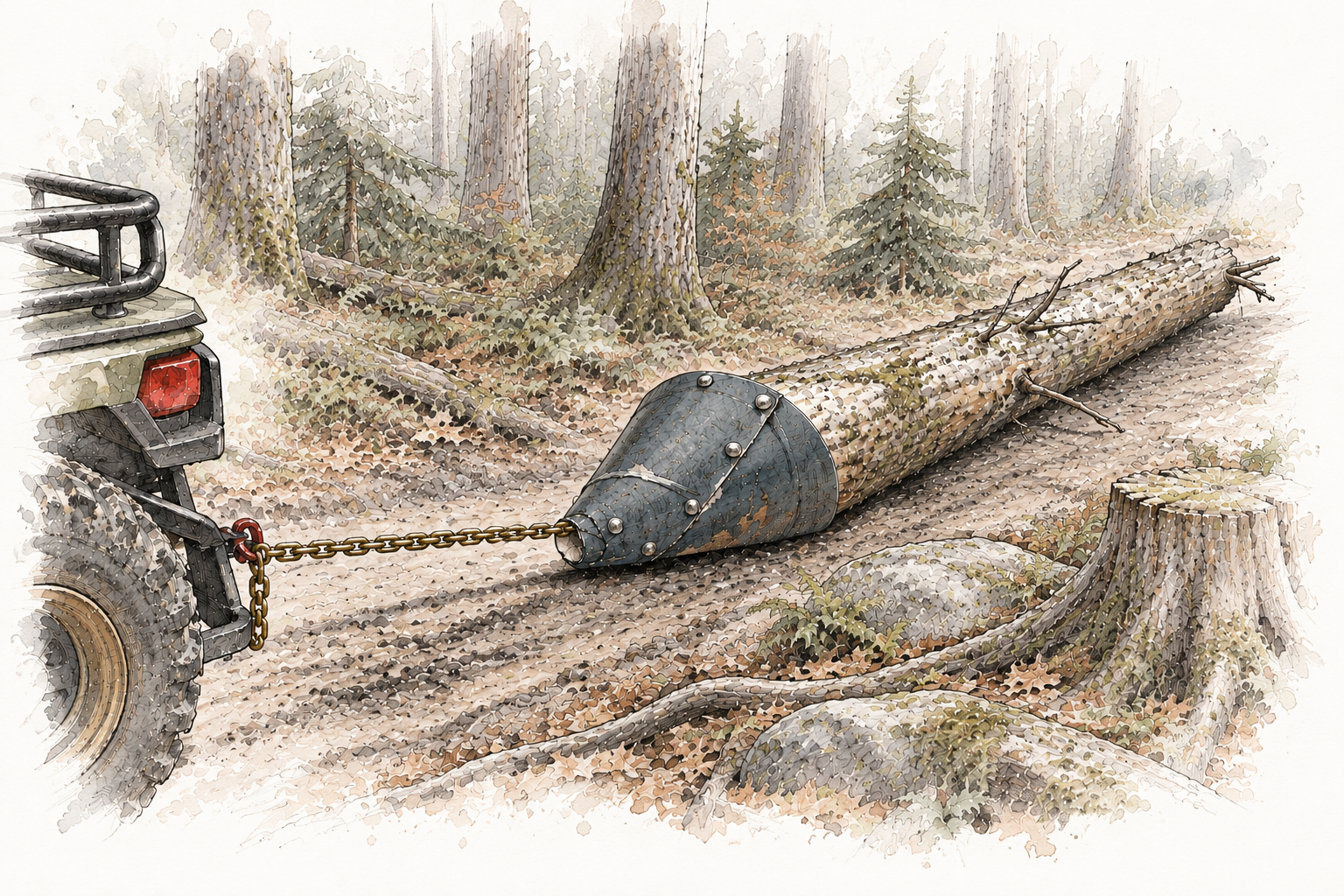
Improving Direct Skidding with a Skidding Cone
One of the simplest upgrades a landowner can make is adding a skidding cone to the front of the log.
The cone creates a smooth leading edge that helps the log climb over obstacles instead of catching on them. Rather than digging into roots, rocks, branches, and stumps, the leading end can slide more smoothly through the forest.
Benefits of a Skidding Cone
-
-
Reduces snagging
-
Helps the log track more predictably
-
Reduces side-to-side swinging
-
Helps reduce unwanted rolling
-
Reduces shock loads on equipment
-
Lowers pulling resistance
-
While a skidding cone will not eliminate every obstacle, it can dramatically improve both control and efficiency, especially on rough woodland trails.
Key Takeaway
Direct skidding remains one of the easiest ways to begin moving logs around a property. Success comes down to three things:
-
-
Read the Trail: Look for obstacles before you start pulling.
-
Read the Ground: Terrain and conditions affect traction, control, and effort.
-
Read the Log: Understand how the log is likely to roll, swing, and react as it moves.
-
The challenge isn’t usually pulling the log. The challenge is controlling the log
Want to learn more about log skidding and log extraction? Read Chapter 2 to read about how log arches are the next step up over direct log skidding.
The Woodland Mills Log Extraction Guide: Learn more about every step, piece of equipment and stage of log maneuvering, from low-cost skidding to more specialized equipment and knowledge.
Chapter 1: Direct Log Skidding
Chapter 2: Log Arches
Chapter 3: Forestry Winches
Chapter 4: Utility Trailers
Join the Woodland Mills Community Facebook group. Search advice and insights from over 65,000 knowledgeable, supportive members.
- Pre-purchase considerations
- Sawmill set-up support
- Project inspiration photos and videos
- Community troubleshooting support