



How to Haul Logs: A Log Skidding and Log Hauling Guide to Transporting Timbers
Looking to load up and haul logs off-grid or across rough terrain? Here are some helpful tips for travelling with timbers
Log hauling is a key part of harvesting logs from your own property, but some landowners struggle with how to handle the task.
There are many different ways to haul and dump logs, whether you're hauling single timbers to stacks of firewood or logs for milling on your portable sawmill.
This guide will explore how to transport logs, from easy solutions using equipment you may already own, to more technical solutions with specialized, trusted forestry equipment.
So let's explore the realities of log hauling and how you can safely and quickly bring your logs to your storage site, log pile or sawmill operation.
Why do I need to haul logs across my property?
Rural landowners with forested land often need to harvest trees, whether it's a one-off due to storm damage or for routine harvesting in a woodlot.
It's a smart idea to have a reliable way to transport logs, since logs can often be large, heavy and unwieldy without the right equipment like a log arch or dedicated log-hauling ATV trailer.
And there are times when tree harvesting is needed in off-road terrain, deep in the brush, where you can't just pay someone to freight your fallen timbers to your log pile.
Because of that it's wise to have a dedicated method, and the right equipment, to transport logs across your property, whether you have vast untamed wilderness, a dedicated and well maintained trail network or a series of farmers' fields.
The right machines can get the job done quickly so you can move onto the next task.
Why Direct Skidding Is So Popular
For many landowners, direct skidding is the natural starting point.
The concept is simple: attach a chain or choker to a log and pull it with a tow vehicle you already own.
The benefits of log skidding:
-
-
Lowest-cost extraction method
-
Uses existing equipment
-
Minimal setup required
-
Effective for occasional firewood and sawlog movement
-
When distances are short and ground conditions are firm, direct skidding can be surprisingly productive.
Understanding the Challenges of Log Hauling
The challenge is rarely attaching the log. The challenge is getting the log through the woods.
That is why the extraction route matters so much.
Unlike equipment travelling on wheels, the entire log must navigate every root, stump, rock, branch and tight turn along the trail. A tow vehicle may have enough power and traction to pull the log, but a single snag can quickly bring everything to a stop. That's why specialized forestry equipment such as log arches like the Loglander 28 or multi-purpose log hauling trailers like the Multilander are so popular with landowners.
Hauling single logs vs a stack of logs
If you're only ever hauling a single log, your solutions will be different from the landowner that has to haul many.
For single log hauling jobs you can use:
-
-
A simple log arch like the Loglander 20 attached to an ATV or truck
-
A forestry winch
-
For hauling many logs you may need:
-
-
A high capacity log arch like the Loglander 28
-
A forestry winch
How do I pull logs out from the dense brush of my property?
There are a number of great ways to pull fallen logs out from the dense brush of your land. Here are a few key techniques you may want to put to use, and the equipment you'll need to do them.
Winch and Log Arch
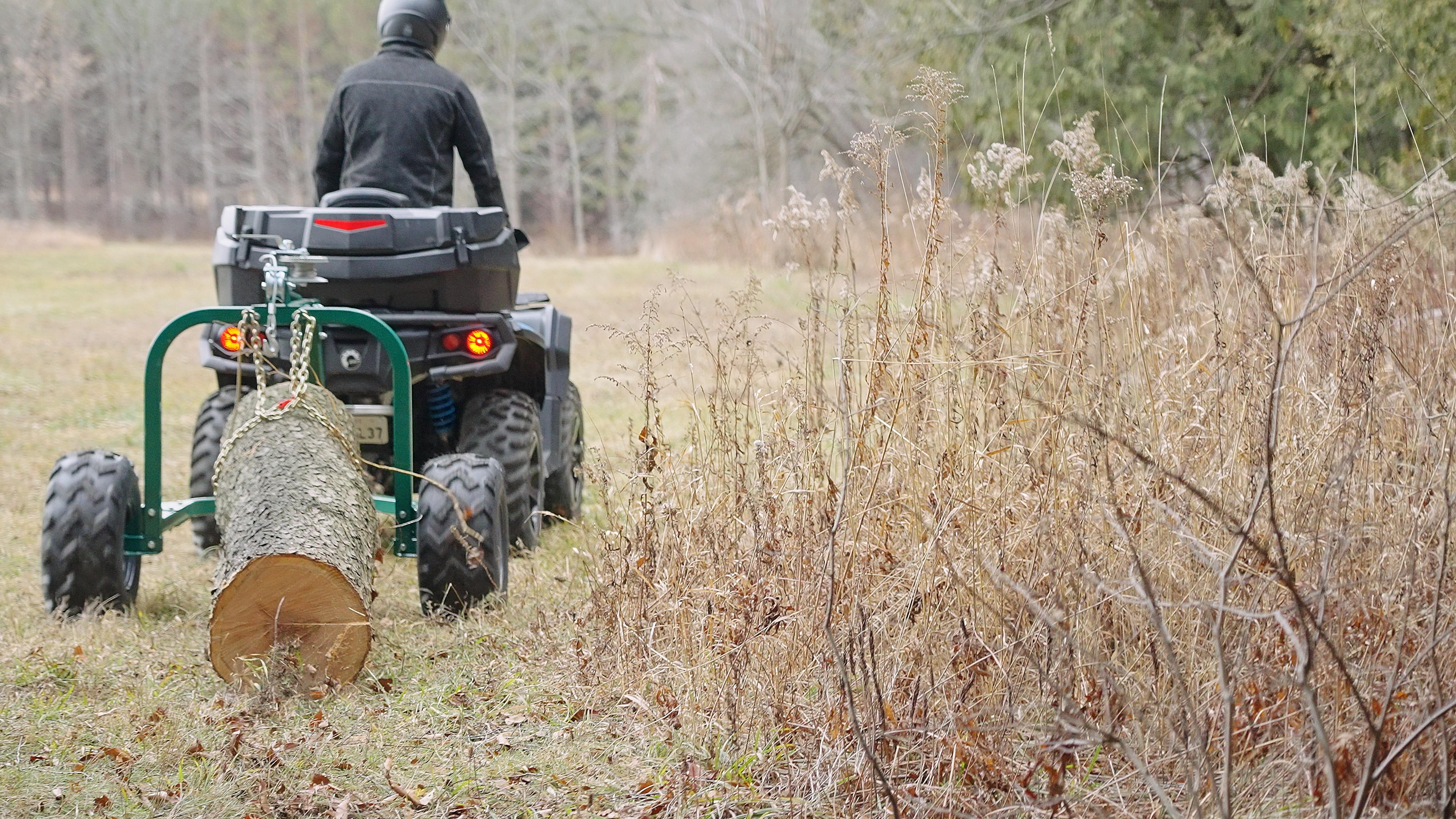
A log arch is a great tool for skidding logs across your land. The accompanying winch makes for a great tool for pulling logs out of nearby brush, and allows you to do log hauling with just an ATV. This ensures you have a tight, highly maneuverable setup, great for pulling logs out from the side of the road, a trail or smaller forest stands.
Log arches are great for pulling out individual logs, and the Loglander 28 can pull out and transport logs up to 28" in diameter, with a winch that can haul up to 2,500 lbs.
Winch and ATV Trailer
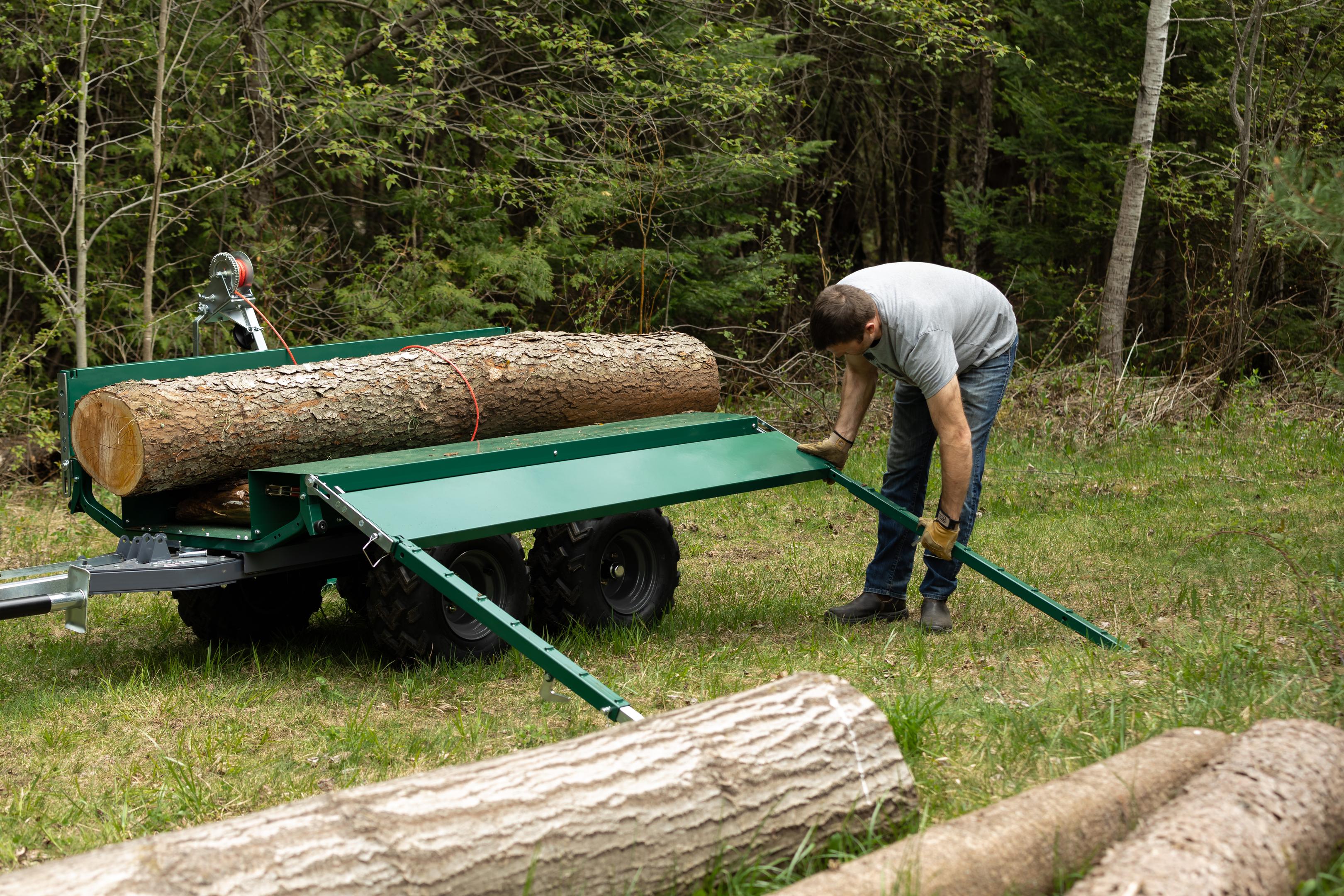
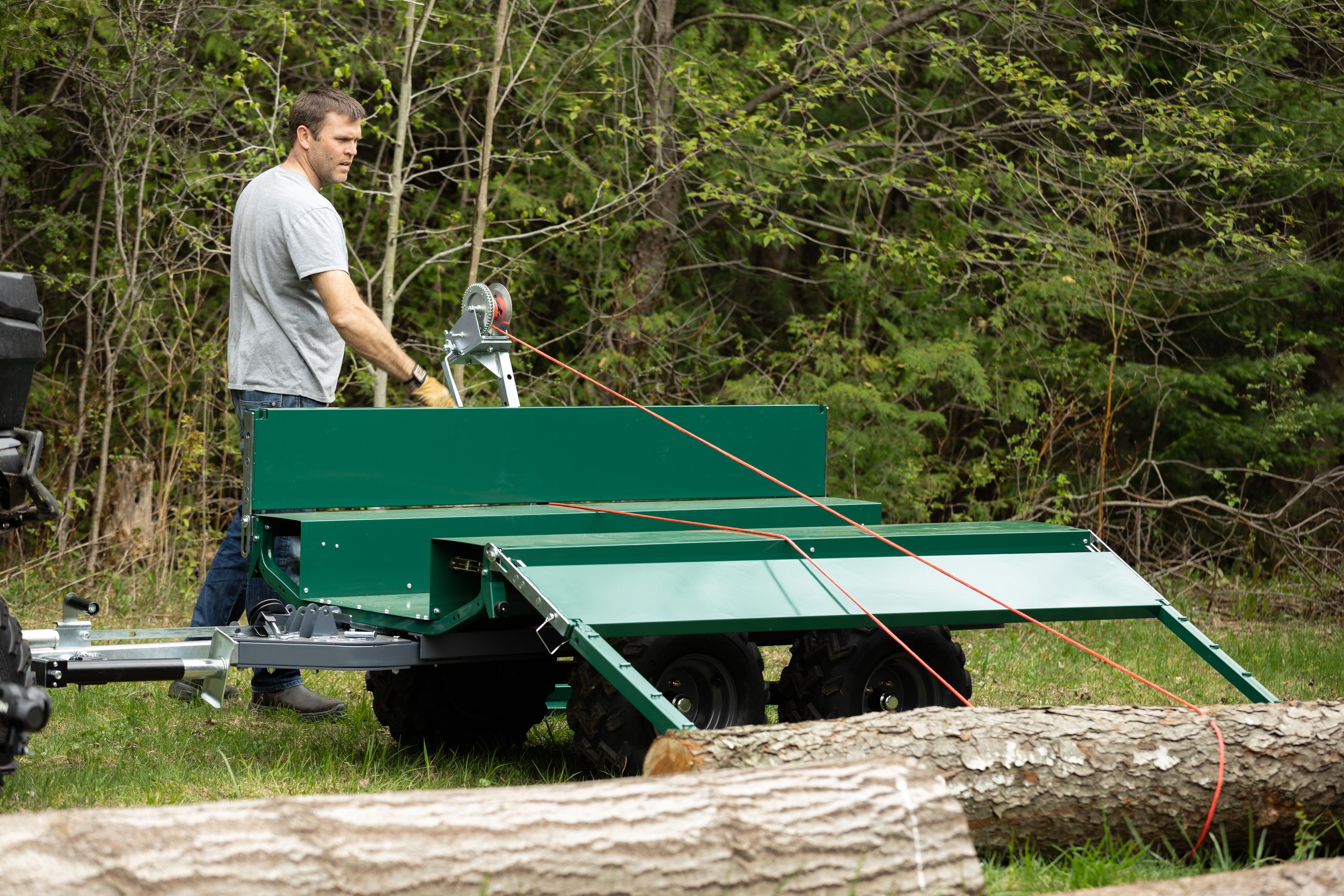
An ATV trailer like the Woodland Mills Multilander is excellent for harvesting and hauling a high quantity of logs around your land. With a 2,000 lb payload capacity, you can easily carry a number of logs across your land.
The lowering side rail and included ramps, alongside the 2,500 lb winch, gives you the ability to easily roll logs into the trailer box.
This setup is well designed for landowners who already have a log pile, or who can pull logs out from the brush on their own. While you can use the winch on the Multilander to pull logs out from the forest, it does require proximity to the logs, and if you don't have a trail or access point to get to them, that may not be possible.
Log trailers like this with a winch are an ideal setup for carrying logs across your land, which you may want to use in combination with other methods of pulling logs out that are buried deeper into your forest.
Self-Releasing Snatch Block
A self-releasing snatch block is incredibly useful for pulling logs out from uneven terrain. This pulley system can be utilized with a winch or skid, and can be used to wrap the line around trees or sloped terrain, and automatically releases when the log reaches it. This ensures a controlled path for the log and gives you greater control over how you maneuver your logs across your land, letting you trek your logs across uneven, difficult terrain much more easily.
This gives you a high level of access to logs across your land, since you're no longer stuck harvesting logs from just flat, level terrain, or land that's easily accessible via trail or road access. Now you can harvest more remote trees that are harder to reach via vehicle or on foot.
Forestry Winch
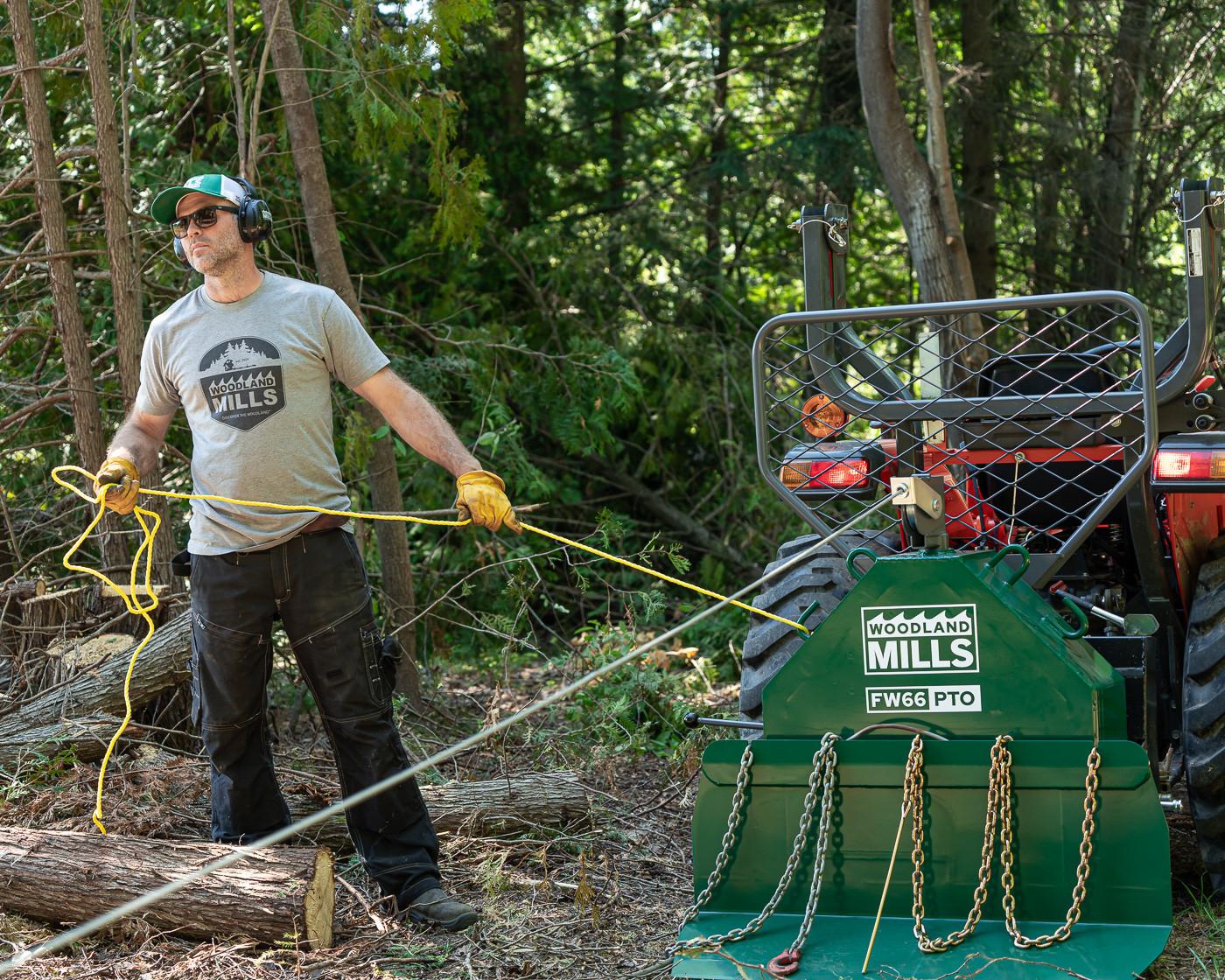
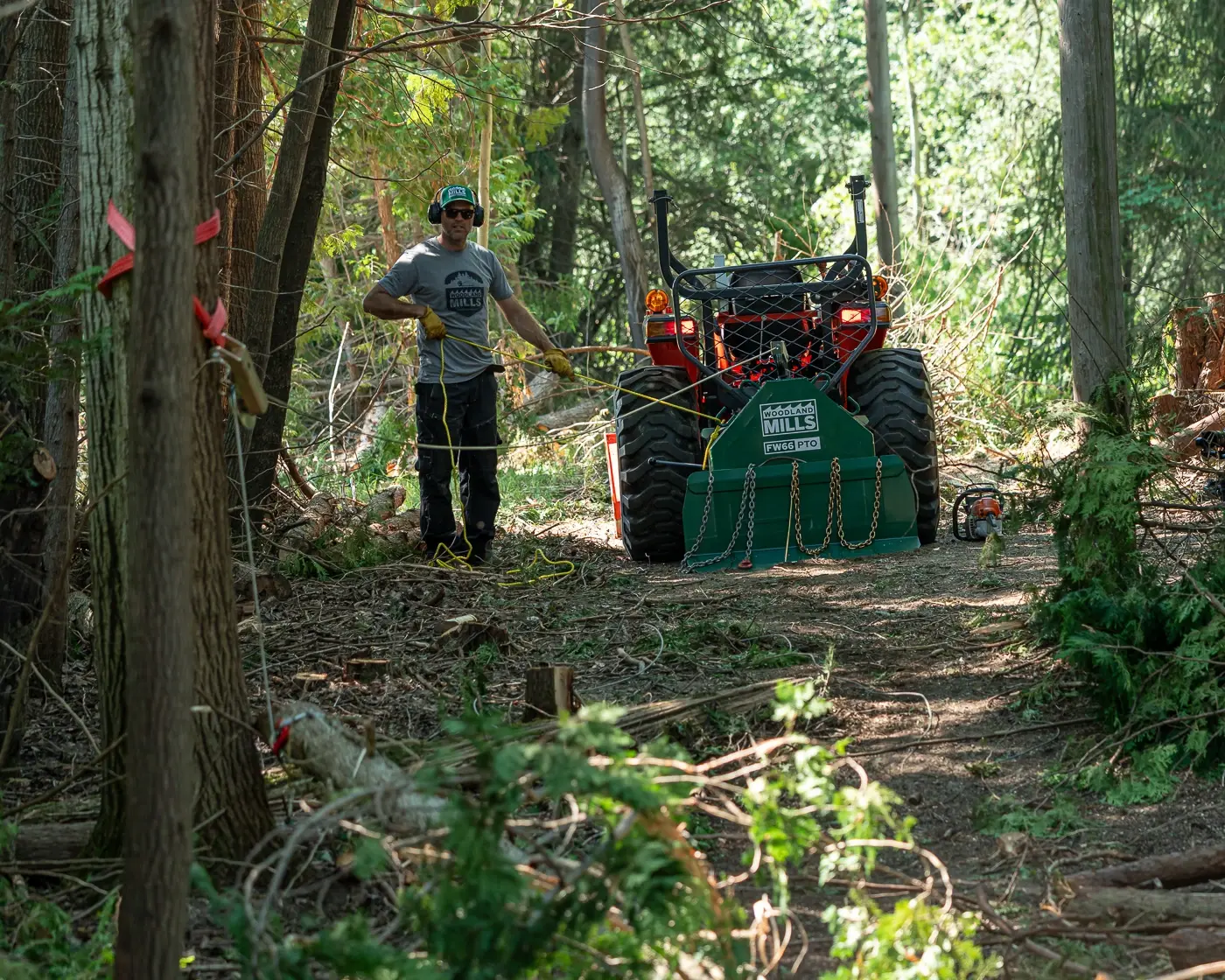
A forestry winch is a piece of equipment used with a tractor that has a PTO. The tractor's PTO powers the winch, which can be used to pull logs out from dense foliage, all while the tractor is positioned at the edge of the tree line.
A winch like the Woodland Mills FW66, provides more than 6,600 lbs of force to help pull your logs from the forest, while you stand safely with your tractor. This setup is excellent for landowners who own a tractor and want greater ability to pull out logs from their land that might be otherwise difficult to access off trail or manually pull or drag out.
A forestry winch makes sense for landowners with a tractor who are looking to access logs embedded off-trail and have a way to transport them across your property.
The Log Has a Mind of Its Own
As the log moves across uneven terrain, it constantly reacts to its surroundings.
A log may:
-
-
Roll unexpectedly
-
Swing left or right
-
Drift across the trail
-
Pivot when one side catches an obstacle
-
Change direction as terrain conditions change
-
A log that starts out travelling perfectly behind the tow vehicle can quickly move off-line after encountering a root, stump or rock. That's why control is such an important factor to deciding which tow-behind method you should use. Consider the terrain you're navigating and the type of tow vehicle before deciding whether an ATV trailer, log arch, winch or other method is best for you.
Consider the Condition of the Log
Direct skidding can also be hard on the log itself.
Because the log is dragged directly across the ground, bark is frequently scraped away and the surface can become damaged from repeated contact with roots, rocks and stumps.
Ground conditions play a major role.
-
-
On frozen ground: logs generally stay cleaner and slide more easily, making winter one of the best times to skid timber. However, those same frozen conditions may reduce traction for the tow vehicle. The log may pull more easily while the tow vehicle struggles for grip.
-
In warmer conditions: logs tend to pick up dirt, mud, sand and small stones. This may not matter as much for firewood, but it can be a significant consideration for sawmill owners. Dirty logs can dull blades faster, increase maintenance requirements and reduce milling efficiency.
-
The less ground contact a log has during transport, the cleaner and better protected it will remain. A log dolly like the LD20 can lift the end of the log to protect it and also reduce dragging and potential damage to trails, grass or other terrain.
Harvesting logs in environmentally sensitive areas
Some acreage is considered sensitive due to close proximity to protected wetland, or due to protections put in place to guard vulnerable species.
In these cases ensure you are following all local procedures before harvesting, including:
-
-
Consulting with your local government agency to ensure harvesting is okay
-
Ask an arborist or logging professional about logistics of harvesting in these areas
-
Document your tasks so if there's any issues you can show the extent of work you've done
-
In these areas it's wise to perform low-impact harvesting, ideally utilizing trees that have already fallen from storms. If you're dragging your logs then consider a Woodland Mills log dolly to better protect the soil and mitigate disruptions to the native environment. In cases where it's necessary to fell a tree, utilize best practices for controlled harvesting so the tree falls in a secure area.
Scenario: What is the best equipment setup for hauling trees in dense, difficult terrain?
If you plan on harvesting specific trees from private or unmanaged forest, you will want a setup that is:
-
-
Mobile
-
Maneuverable
-
Can access logs without needing to get close to them
-
An ATV trailer with a winch and log arch can be an incredibly useful setup for harvesting specific trees from your land. This is great for landowners with trails running through their forests, where they can quickly and easily setup their winch to pull logs out and get in and out of their forest with ease.
For more unmanaged, dense and unmaintained forest, a self-releasing snatch block will be handy for grabbing logs on sloped, uneven terrain.
If you can drive your tractor up to the edge of your forest stand then a forestry winch will be a very handy device to pulling out logs, giving you the power of a tractor to pull out logs that might get tied up and stuck on branches.
Scenario: What is the best equipment for harvesting trees from a woodlot or flat, level property?
Woodlots are naturally easier to manage, since trees are planted in rows that are easier to drive a tractor or ATV through. Oftentimes landowners specifically plan around this, giving themselves plenty of room for felling and harvesting specific trees that aren't growing right or that might harm the overall health of the stand.
For this purpose an ATV with a log arch may be sufficient, since this gives you quick access to your trees. If you're concerned about disrupting the forest floor you may want to consider a log dolly that keeps your log lifted and avoids it dragging across the ground. This is also helpful for keeping trails and grass in top shape.
The difficulties of tree harvesting on sloped, challenging terrain
This is likely one of the most difficult ways of tree harvesting. At times it may be necessary to harvest a tree from sloped terrain, whether it's been damaged in a storm and needs to come down, or it's an ideal tree for harvesting because of its size or species.
If safety is a concern, consult an arborist or tree care company. Don't tackle tasks beyond your abilities.
If you do have the skills to handle a tree like this, utilize directional tree felling, the practice of cutting a wedge and/or using straps, so it falls in an ideal path. Utilize tensioned straps to stabilize or direct the tree while you're cutting into it with a chainsaw.
Once it's felled, using a winch to pull it out of the difficult terrain would be ideal, whether you're using a PTO-powered forestry winch or one equipped to a log arch or ATV. A self-releasing snatch block allows you more freedom to wrap your line around a tree or obstacles while maintaining a controlled path for the log to your winch.
Utilizing your wood waste for firewood or wood chips
Part of utilizing the resources of your land is mitigating waste, ensuring every part of the tree is used to contribute to the overall health of your land.
Parts of the tree that can be reused include:
-
-
Tree Branches: Using a wood chipper like the WC68, convert your tree branches and other wood waste into a pile of wood chips to spread across your trails, as animal bedding or in your garden.
-
Leaves and foliage: Create a compost pile and put your fresh green waste to turn it into a healthy mulch for spreading on crops or in your flower garden.
-
Bark: Utilizing a debarker chainsaw attachment, turn the waste bark from your logs into either mulch or spread it as decorative wood chips in your garden or planter boxes.
-
Large branches/smaller rounds: Wood that's too small to be milled for lumber can instead be split for firewood, using a log splitter like the LS218.
-
Why do landowners trust Woodland Mills for their forestry equipment needs?
For more than 15 years, Woodland Mills has focused on smart engineering, dependable construction and direct customer support. Our equipment is designed for landowners who want to manage more of their forestry and property-maintenance work themselves.
Customers regularly highlight product quality, detailed assembly instructions and knowledgeable service in their reviews. Woodland Mills works directly with customers when they are selecting compatible equipment, assembling a new machine, ordering replacement parts or maintaining it over time.
"Pulled a bunch of logs out of the forest on the weekend, some quite large and the arch made the job of skidding them to my woodlot much easier on the tractor, on my body, and on the logs," says TA24 owner Glen H. "Wish I’d bought one earlier."
Landowners can also turn to the Woodland Mills Product Owners and Community Facebook Group, where tens of thousands of owners and enthusiasts share equipment setups, project ideas, maintenance experience and practical advice. That combination of capable equipment, ongoing support and an active owner community helps customers take on demanding forestry projects with confidence.
What other equipment might you need for land management?
Loggers and forested landowners rarely just need a chainsaw and an ATV, they often end up with an arsenal of equipment to perform a variety of tasks throughout the year.
Here are some recommendations for other Woodland Mills products that may assist your property management journey:
-
-
A PTO wood chipper for your tractor like the TF810 PRO can reliably chip your fallen tree debris, including wet, green, recently cut branches
-
Accessories like and log handling tools like cant hooks are essential for log rolling
-
A stump grinder like the WG28 PRO is used by landowners to clean up stumps and prepare land for future use
-
Key Takeaways
Direct skidding remains one of the easiest ways to begin moving logs around a property and success comes down to three major factors:
-
-
Read the Trail: Look for obstacles before you start pulling.
-
Read the Ground: Terrain and conditions affect traction, control and effort.
-
Read the Log: Understand how the log is likely to roll, swing and react as it moves.
-
The challenge isn't usually pulling the log. The challenge is controlling the log. Utilize the best equipment that offers the greatest amount of control for your setup.
FAQ: Frequently Asked Questions
Q: What is the best equipment for a trip delivering a log to a nearby property?
A: For delivering a single log down the road, you can utilize an ATV equipped with a log arch or a trailer. If you own a truck with a ball hitch you could also attach your trailer to that, since Woodland Mills trailers are easier to load logs onto than the bed of your truck.
Q: What's the easiest way to haul many logs for building a house?
A: We recommend a high capacity ATV trailer like the Multilander, that not only features a 2,000 lb payload capacity, but also included ramps for side-loading logs, allowing you to easily roll them utilizing the accompanying 2,500 lb capacity winch. This is an efficient solution that allows you to haul the maximum amount of logs your ATV can carry.
Join the Woodland Mills Community Facebook group. Search advice and insights from over 65,000 knowledgeable, supportive members.
- Pre-purchase considerations
- Sawmill set-up support
- Project inspiration photos and videos
- Community troubleshooting support